August 27, 2026 · BTCD Team
$62,000 to $80,000 in eight days. Some Bitcoin treasuries sold that exact move for pocket change.
Bitcoin went from roughly $62,000 on August 16 to touching $80,000 on August 24. Call it a ~29% move in eight days.
Old-timers will shrug. Moves like this used to be Bitcoin's whole personality, 2017 and 2021 had bigger weeks. What makes this one different is what came before it: nothing. Bitcoin had gone dead quiet. Options traders were paying record-low prices for a rally — in early August, the cost of betting on Bitcoin upside hit an all-time low. The market had stopped paying for the possibility that Bitcoin goes up.
Part of why: a lot of people were getting paid, month after boring month, to sell that possibility.
Meet the DATs
Digital Asset Treasury companies. Public companies whose entire pitch is "we hold Bitcoin, buy our stock." Public-company treasuries now hold over 1.26 million BTC, more than 6% of all the Bitcoin that will ever exist.
The model works great in one direction. If your stock trades above the value of your coins, you sell shares, buy more Bitcoin, repeat. By this year the machine jammed. The premium collapsed across nearly the whole sector, and by this summer most of these companies traded below the value of their own coins — including the giants. Twenty One, the second-largest holder on earth, traded at a steep discount to its own Bitcoin in August. Even Strategy's enterprise value slipped below its coins in June. Below that line you can't sell shares without shortchanging your holders, but the bills don't stop. Salaries, interest, listing fees. A pile of Bitcoin doesn't pay payroll.
So the treasuries went hunting for dollars. And a bunch of them found the easiest yield in the book: selling covered calls.
Selling the one thing you exist for
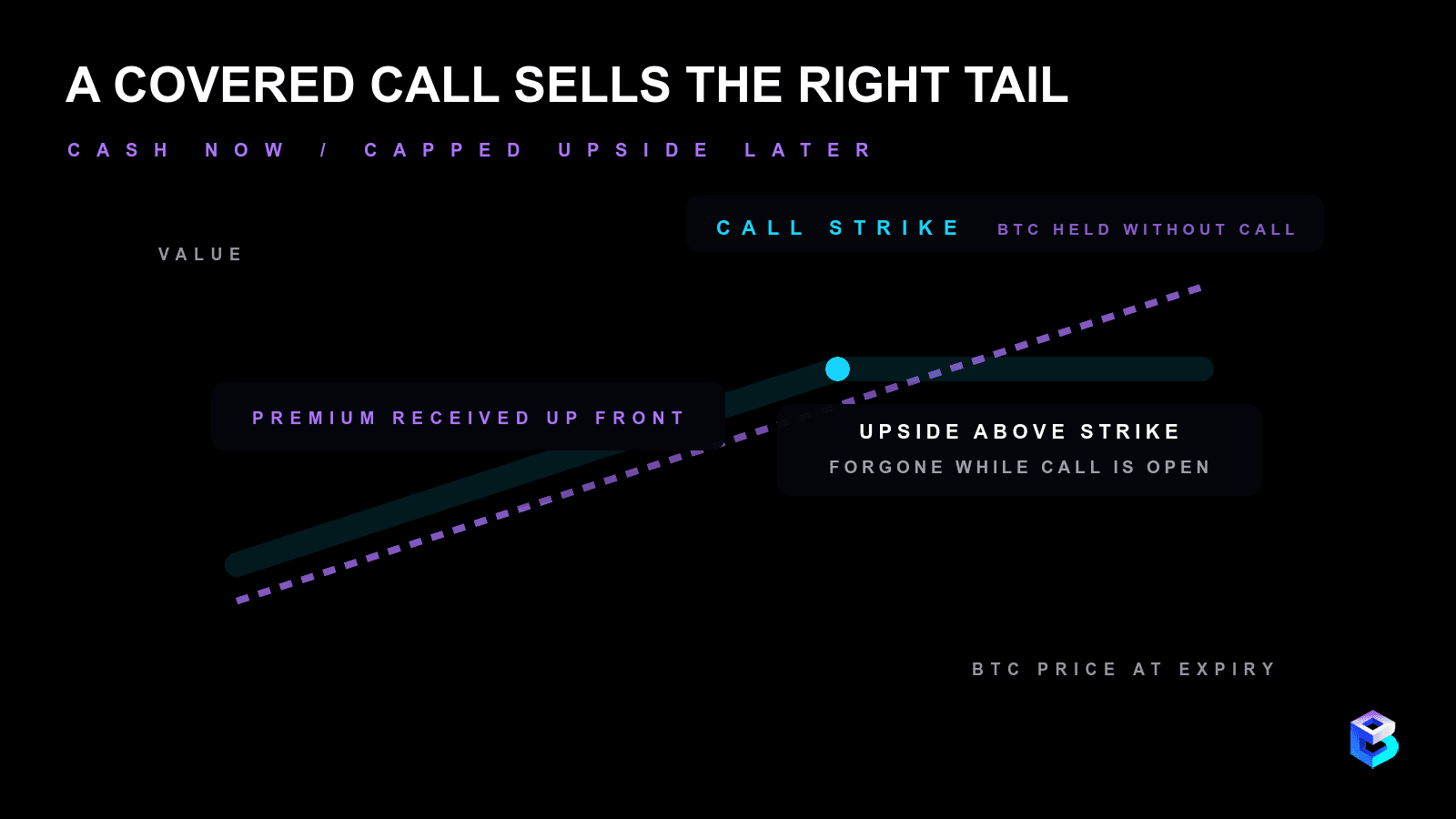
A covered call is simple. Someone pays you cash today for the right to buy your Bitcoin at a set price later. If Bitcoin never gets there, you keep the cash and the coins, feels like free money. If Bitcoin rips through the strike, your coins get called away at the old price. You sold the rally.
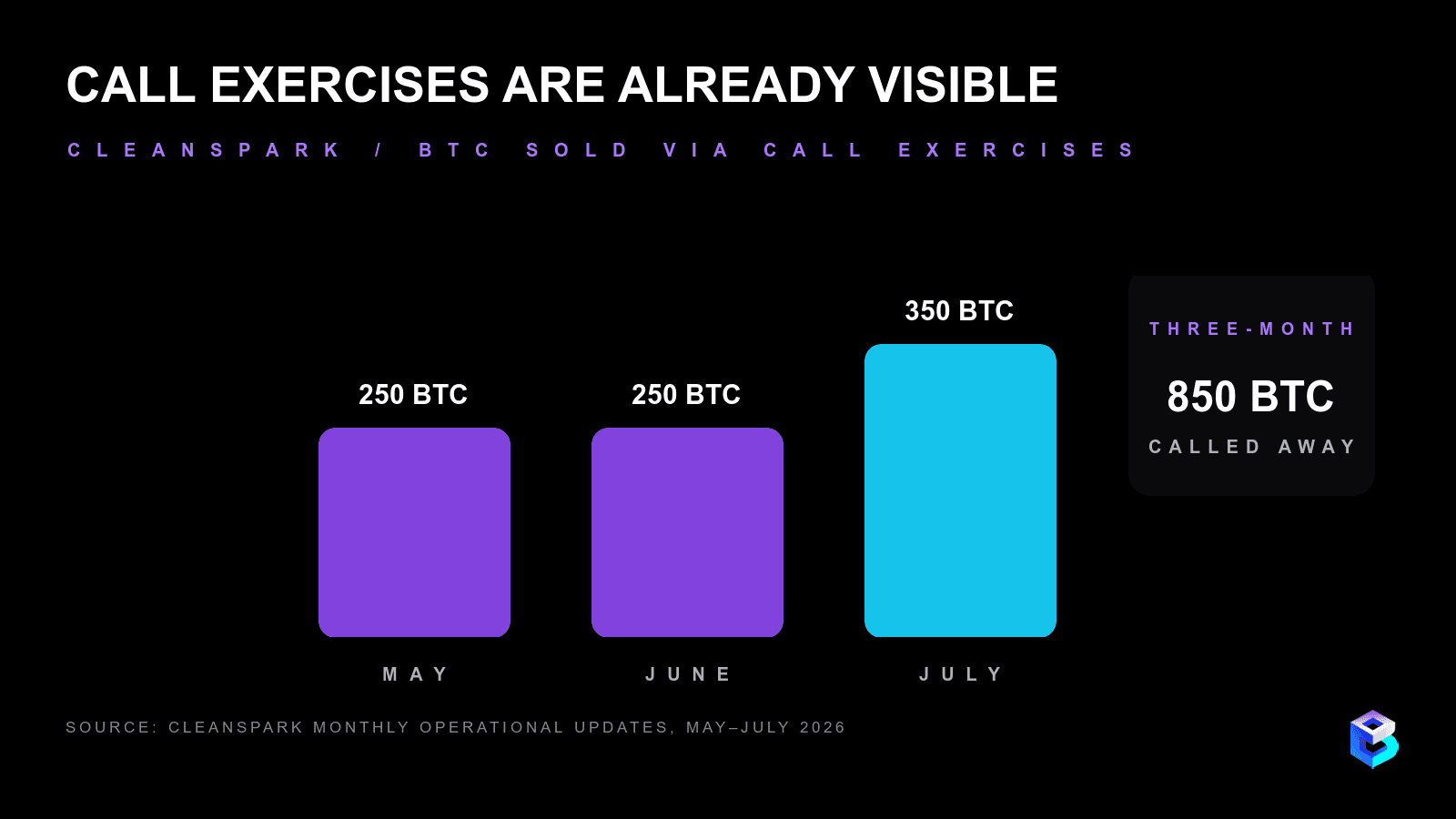
This isn't hypothetical, it's in the filings. CleanSpark disclosed that in June alone it sold 250 BTC "pursuant to call exercises" — coins that walked out the door at yesterday's prices because Bitcoin went up. MARA has routed thousands of coins into managed yield programs.
And it's not just miners. Metaplanet, the third-largest corporate Bitcoin holder on earth, built a whole business segment around writing options against its stack — puts and covered calls in rotation. Option premiums drove a 17-fold jump in its operating profit last year, and it's guiding to ~$100 million of revenue this fiscal year, nearly all of it from that machine. Its options income actually fell 41% last quarter because volatility got too low — meaning it was selling upside for record-cheap premiums with Bitcoin at $60,000, right before the rip. Empery Digital, a pure Bitcoin-per-share vehicle, discloses in its SEC filings that it trades short-term put and call contracts to generate income on its coins. DDC Enterprise hired QCP, one of the biggest crypto options desks, to run derivatives "yield enhancement" on its treasury. The pitch was everywhere. Your coins are just sitting there. Rent out the upside.
A Bitcoin treasury company has exactly one job: hold the upside. That's the product. Selling calls against the stack is a fire department selling off its water supply because the hoses were just sitting there.
In a flat market it looks smart. Then Bitcoin ran 29% in eight days and the trap sprang.
The earnings call nobody wants to give
Picture the Q3 call. Bitcoin is up huge. Your shareholders are finally euphoric. And you have to explain that you hold fewer coins than you did during the bear market, because you sold the upside during the quiet and the rally you existed for just called it away.
Nobody wants to make that announcement.
Why this feeds on itself
Here's our read of what happens next. The option programs are documented, the scrambling is our bet.
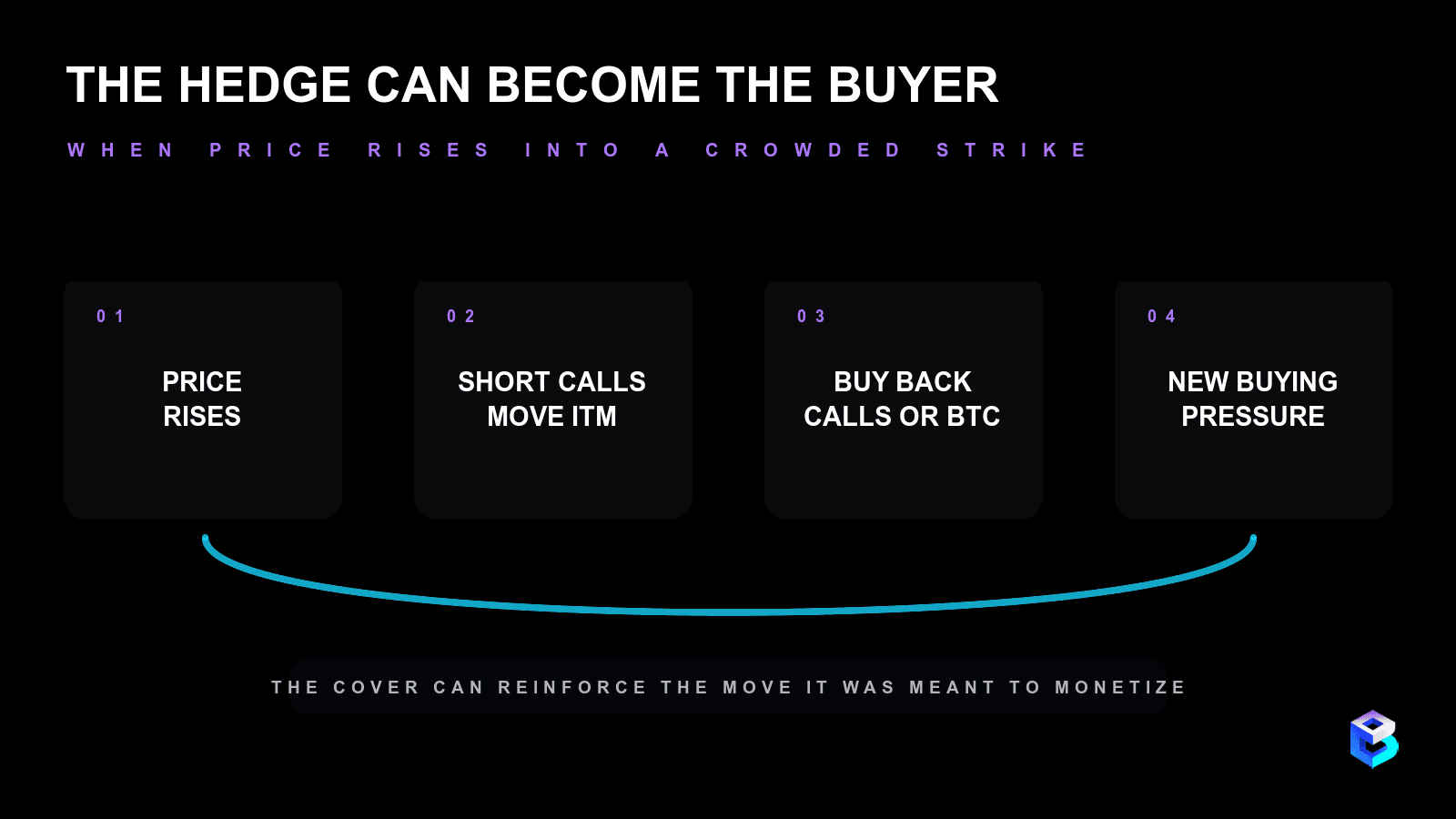
A treasury that doesn't want to hand over its coins has to buy those calls back, or buy Bitcoin to cover, and it has to do it in a rising market. Every one of those trades is a buyer. So is every fund that was short volatility and now has to cover. Buying pushes price higher. Higher prices push more sold calls into the money. Which forces more buying. Round it goes.
The $80,000 call strike had been one of the most crowded in the market for months. On August 24, Bitcoin tagged it.
And the kicker: even when a treasury's stock finally rallies enough to sell shares again, that fresh cash isn't buying net-new Bitcoin. It's digging out of the options hole first.
Not everyone has to buy it back
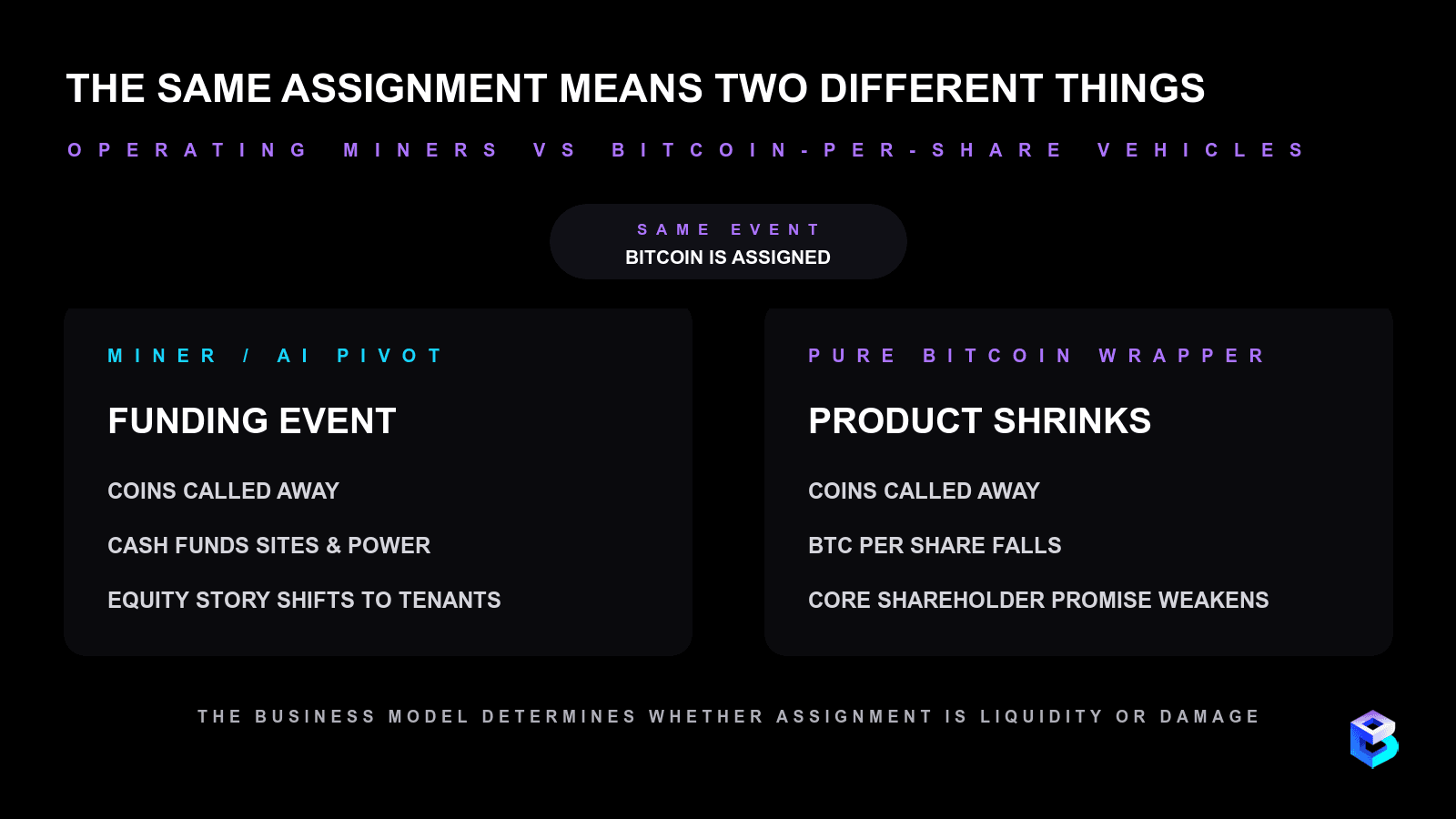
An honest carve-out. Some of these miners are transitioning into AI data center plays, and their shareholders won't mind them shedding BTC. MARA signed a deal with Starwood in February to convert mining sites into AI datacenters and bought a power plant to anchor an AI campus. CleanSpark now describes itself in its own SEC filings as a data center developer. For these companies, coins getting called away isn't a crisis, it's a funding event — shareholders grade them on megawatts and tenants now, not coin count. MARA sold ~$1.5 billion of Bitcoin this year to fund exactly that.
The pure-plays get no such exit. Metaplanet's whole story is coins per share — it's targeting 210,000 BTC by the end of 2027. Empery's whole pitch is Bitcoin per share. When your ticker is just a Bitcoin wrapper, you can't pivot your way out of a shrinking stack, and every call that lands in the money is a hole you fill at higher prices. That's where the forced buying lives.
Gold already ran this experiment
In 1999, gold sat at a 20-year low and miners had sold away years of future upside to lock in cash. Then central banks capped their gold sales and the price jumped ~25% in a few weeks. Ashanti Goldfields, the third-largest producer on earth, got hit with ~$270 million in margin calls it couldn't meet and was effectively bankrupted by its own product going up. It took the industry a decade to unwind. In 2009, Barrick raised billions in stock and ate a $5.6 billion charge just to buy back the upside it had sold. That forced buying sat under the gold price for years.
Producers selling away their own upside for income, then buying it back into a rally. Swap ounces for coins and you've got 2026.
There's a better way to earn on Bitcoin
Not all Bitcoin yield means selling your upside.
Our USD Vault is a structural borrower of BTC, and it currently pays roughly 2.5% APY to borrow it. That means a Bitcoin holder can lend into that demand, earn roughly 2.5% on their coins, and keep 100% of the upside. No strikes, no assignments, no explaining to anyone why the coins are gone.
That's what we mean by sustainable BTC yield. You shouldn't have to sell the rally to get paid while you wait for it.
Sources and further reading
-
CoinGecko Bitcoin historical data
— daily price history for the August 16–24 move
-
— public-company Bitcoin holdings and market-to-NAV context
-
CleanSpark May, June and July 2026 operational updates
— company-reported Bitcoin sold pursuant to call exercises
-
Metaplanet investor presentations
— Bitcoin income-generation results and treasury targets
-
— short-term Bitcoin put and call contracts disclosed in an SEC filing
-
— the announced Bitcoin treasury yield-enhancement partnership
-
— MARA's announced AI and data-center development partnership
-
World Gold Council: producer hedging and the first Central Bank Gold Agreement
— historical context for gold producer hedge books and their unwind
-
Barrick completes the elimination of its gold hedges
— Barrick's 2009 hedge-book closeout and financing
-
— current BTC borrow-demand and supply-rate context
Yields vary with market conditions. Nothing here is investment advice.