November 14, 2026 · BTCD Team
How Big Can a DeFi Vault Get?
“Why can’t we just deposit $20 million?”
Imagine a team asking that question about a vault it wants to use. The amount is hypothetical. The question is practical: if people have capital ready, what else needs to be ready before that capital can start working?
A DeFi vault is software that accepts assets and puts them into a defined strategy. To understand how much it can use, follow the assets beyond the deposit button. What needs to be exchanged? What needs to be borrowed? And what transactions will the strategy need to make later?
Those questions turn a large headline number into a route you can examine.
First, get the right asset
Consider a hypothetical vault whose strategy starts with USDC. A depositor holds a different dollar-denominated token. Before that money reaches the strategy, it needs to be exchanged for USDC.
An exchange pool needs assets on the other side of the trade. Sending more of the depositor’s token into it does not create more USDC.
The trade can also change the price at which it executes. This is called price impact. Its size depends on the trade relative to the liquidity available in the pool. A larger trade through a shallow pool can move the price more than the same trade through a deeper one. Uniswap explains the mechanism here.
The useful question is therefore specific: how much can this route exchange at the execution terms the strategy accepts?
A depositor who already holds USDC skips this conversion in our example. Capacity depends partly on which asset arrives.
Then, find the asset the strategy borrows
Now suppose the strategy also borrows an asset. Completing the USDC swap does not supply that separate lending market.
Imagine a market with 100 units supplied by lenders and 80 already borrowed. That leaves 20 units available before any new supply or repayments. This is an illustrative inventory calculation, not a quoted market balance. Morpho describes lending liquidity as assets available to borrow or withdraw immediately.
The borrowing step needs both sufficient collateral under the market’s rules and available units of the asset being borrowed. Meeting one requirement does not fill the other.
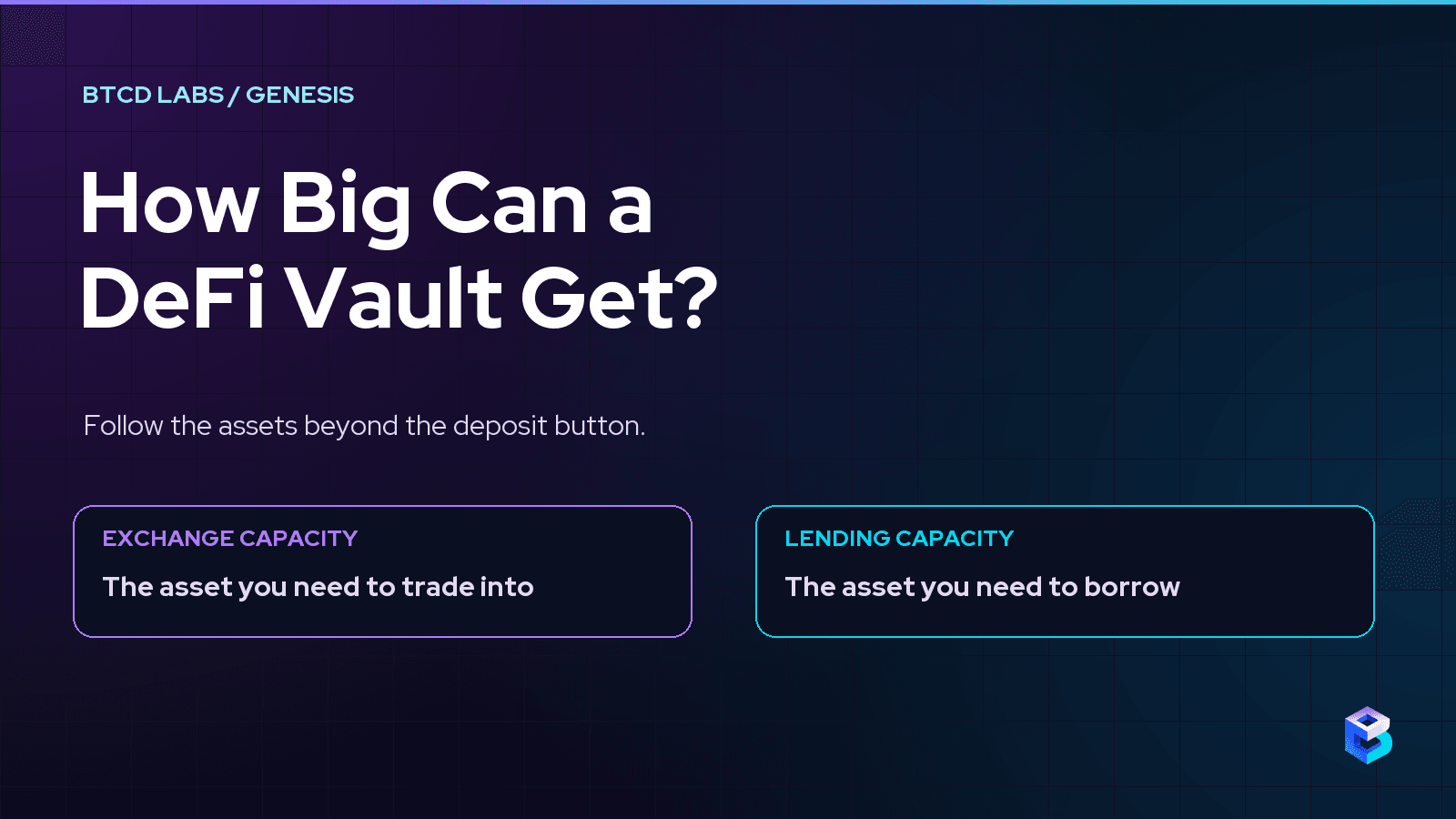
Exchange liquidity answers, “Can I trade into the asset I need?” Lending liquidity answers, “Is the asset I need to borrow available?” They are two different questions, answered in two different places.
In this illustrative route, the exchange supplies USDC and a separate lending market supplies the borrowed asset.
Follow the route beyond the first deposit
A useful way to examine capacity is to follow three moments: entry, ongoing operation and exit. This is a reading framework, not a formula for calculating a vault’s maximum size.
At entry, identify each transaction required to put the deposit to work. In our example, that means a conversion followed by a strategy that includes borrowing. A different strategy may lend directly or use no borrowing at all.
During operation, ask what the strategy needs to adjust. If it changes its asset mix, which trades does that require? If it changes a borrowed position, where do those assets come from? The first successful deposit demonstrates one path at one size and time; a larger allocation deserves its own examination.
At exit, trace how the requested withdrawal asset becomes available. Depending on the strategy, that may involve using an idle balance, selling a position or repaying a loan and releasing collateral. The answer should describe the actual product’s sequence rather than assume every vault works alike.
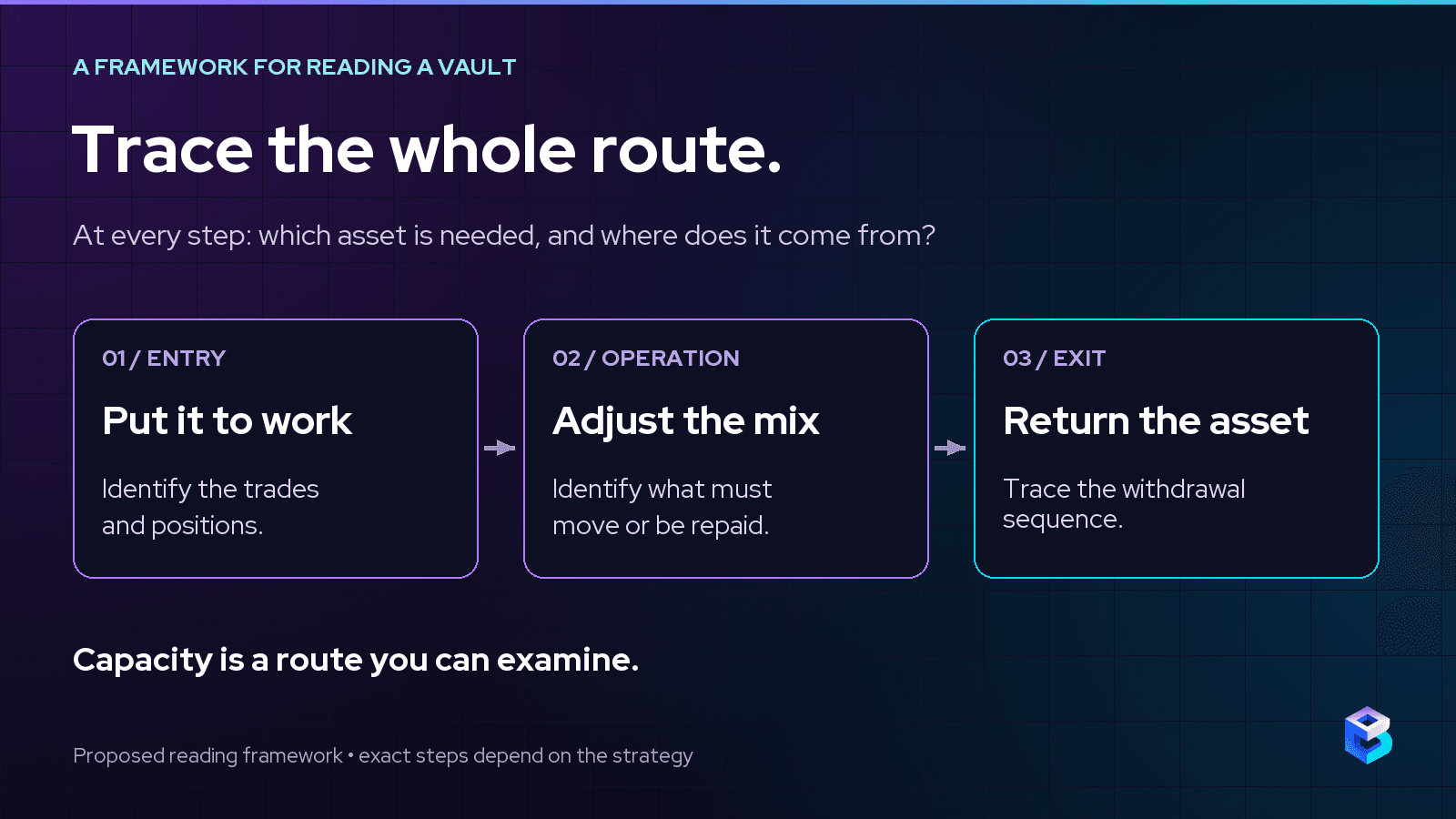
Follow entry, ongoing operation and exit, naming the asset required at each step and where it comes from.
Grow the places capital can work
There is another capacity question after the route is ready: what will the additional capital do?
As a simple arithmetic thought experiment, hold total earnings fixed and increase the capital sharing them. Earnings per dollar fall. That is not a prediction about a particular vault. It explains why a bigger balance and more earning capacity are different things.
An additional strategy can create another place to allocate assets. It still needs a defined mechanism, allocation limits and the liquidity its transactions require. Counting strategies alone does not tell you how much additional capital they can use.
More deposits and more earning capacity are different things; each additional strategy still needs its own allocation limits and liquidity.
This is the capacity question behind the Genesis work at BTCD Labs: how do the routes, assets and strategies fit together as capital grows?
The next useful question after “How much can people deposit?” is “What can that capital do once it arrives?”
Sources
- Uniswap Labs — What is price impact?
- Morpho — Understanding Morpho Vaults: Aggregating & Amplifying Liquidity for Lenders
First published on X.