August 25, 2026 · BTCD Team
Rough Drafts of the Future

Carlota Perez, five glimpses of the future, and the bull run where blockchains and AI transform the world together
In May 2020, in the middle of lockdown, an economist in her eighties logged onto a crypto conference and politely told the industry that blockchain is not a technological revolution.
It might be the most clarifying thing anyone has ever said at a crypto conference.
Her name is Carlota Perez, and if you've been in crypto long enough you've absorbed her ideas whether you know it or not. Every time someone posts the S-curve, or argues the dot-com crash had to happen before the internet could eat the world, that's Perez.
The economist crypto adopted
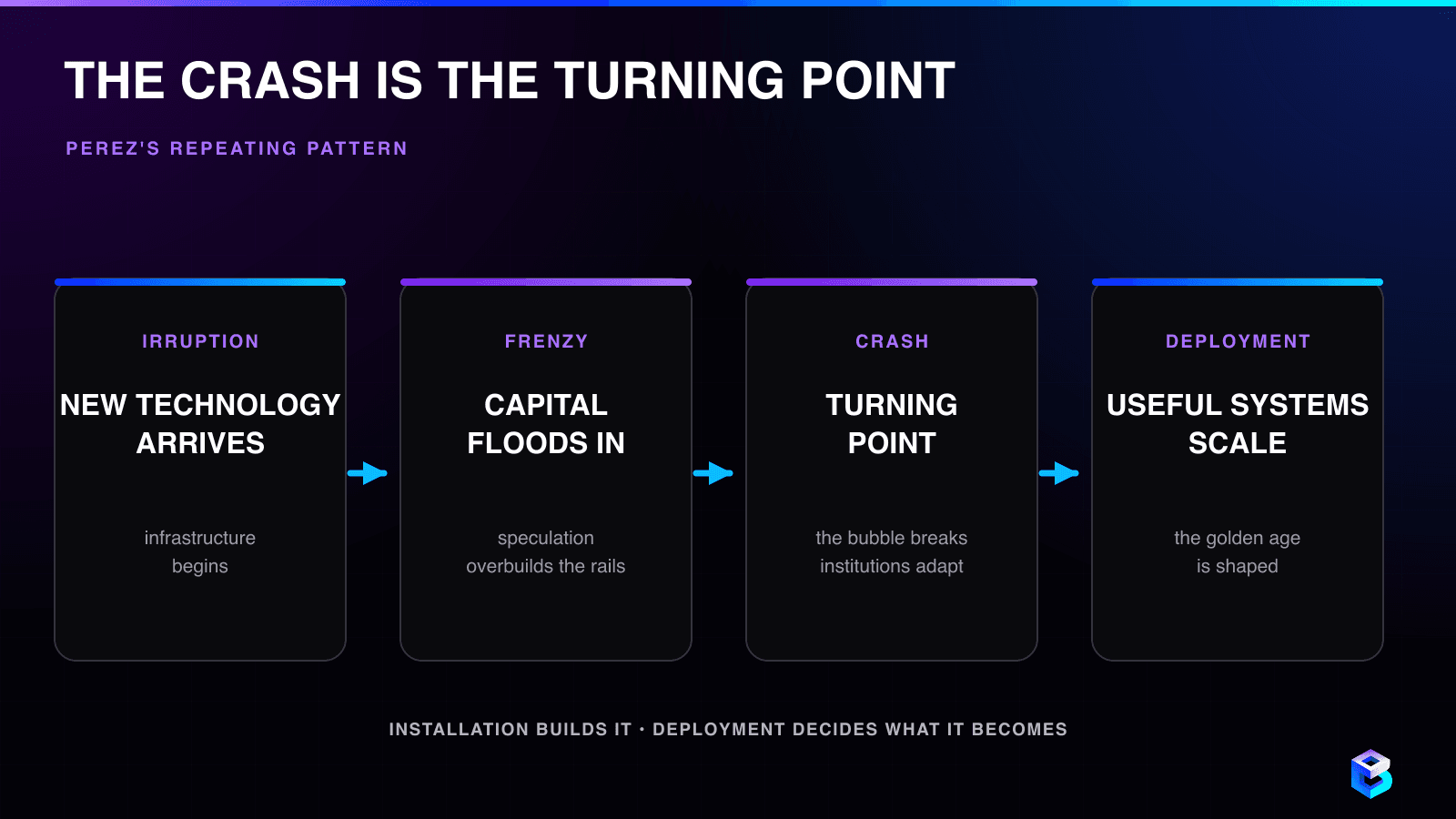
Perez published Technological Revolutions and Financial Capital in 2002. Looking across 250 years of capitalism, she found the same pattern repeating roughly every half century, five times since 1771. A new technology irrupts. Financial capital floods in and inflates a frenzy. The bubble crashes, institutions painfully adapt, and only then, in what she calls the deployment period, does the technology transform how everyone actually lives and works. The golden age comes after the crash, not before it. Canal mania, railway mania, the roaring twenties, the dot-com bubble: same movie, different costumes.
Her framework became venture scripture. Marc Andreessen has called her book the single best guide to how the technology industry works, and Fred Wilson built much of Union Square Ventures' thesis on it. Fred's blog, AVC, is where I first encountered her. It's also where, in 2011, a couple of years after Satoshi published the whitepaper, I first read about Bitcoin. Fred was writing about Perez and Bitcoin in the same breath back then, warning readers that if she was right, crypto's speculative phase would end in tears, and that the tears would be the beginning of the story, not the end. His corollary from her research: "nothing important happens without crashes."
So when Placeholder, the crypto fund Chris Burniske co-founded with USV alum Joel Monegro and whose thesis was explicitly built on Perez ("transitioning from irruption to frenzy"), actually got her in a virtual room, I paid attention.
The conversation that stuck with me
At Consensus: Distributed in May 2020, Perez gave a keynote titled On Blockchains and Technological Revolutions, then sat with Burniske for a dialogue called Seeking Surge Cycles and took audience questions. The guest of honor declined to tell the audience what it wanted to hear, which is exactly why the session holds up.
Her argument, in her own words, was that people conflate a revolutionary technology with a technological revolution. Blockchain is a revolutionary technology. So, she noted, is artificial intelligence. A technological revolution is something bigger: a constellation of revolutionary technologies that together install new infrastructure and a new common sense across the whole economy, the way steam did, the way mass production did, the way the microprocessor did. Five of those in 250 years. Blockchain, in her reading, was not the sixth. It was a powerful technology operating inside the information revolution, plumbing for its deployment period, and maybe, she suggested, a tool for modernizing government itself.
Burniske pushed the other way, as the co-author of Cryptoassets, the book that made the case for crypto as an entirely new asset class, was always going to: crypto as the native financial architecture of the information age, the money and property-rights layer the internet never shipped.
I've thought about that exchange for six years, watching cycle after cycle try and fail to deliver Burniske's ending. I now think his vision was never wrong. It was waiting on a missing ingredient, and the missing ingredient is AI.
Five hallucinations
Every crypto bull run works the same way. The market hallucinates a future, funds it, fails to deliver it on schedule, and crashes. The hallucinations keep being wrong in the specifics and early in the direction. Perez would say that's what frenzies do: they overshoot, they overbuild, and they leave behind infrastructure the sober world later picks up and uses for something else.
Run the tape.
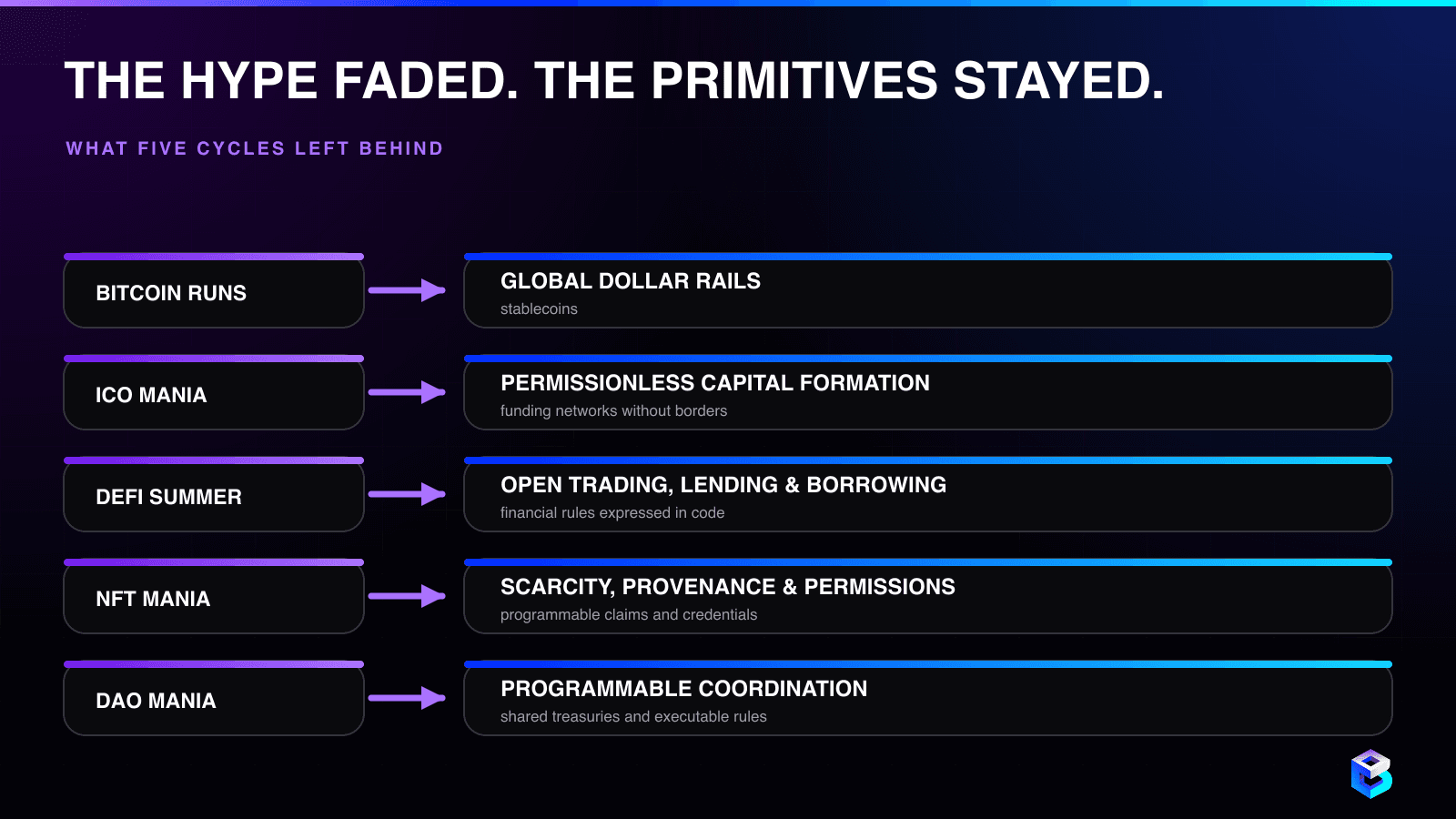
Bitcoin's early runs let us dream that fiat would be replaced outright, and soon. Fifteen years later, the great monetary export of crypto is the dollar. Fiat-backed stablecoins, an instrument a 2013 bitcoiner would have called a surrender, settle trillions per year, operate under purpose-built US law, and are widely expected to have a larger transactional footprint than Bitcoin itself. The rails won.
ICO mania hinted at permissionless, global capital formation: anyone funding anything, from anywhere, with Ethereum itself as the proof of concept. Even the legacy system has conceded the demand is real, in its own incremental way. The JOBS Act's crowdfunding rules and syndicates cracked the accredited-investor wall open a few inches, and a decade later Congress is still inching toward letting Americans qualify by exam rather than net worth. Regulated crowdfunding raised roughly as much in ten years as ICOs raised in a good month of 2018. Then the ratio asserted itself, grifters from within and regulators from without, and a mechanism that could have rewired venture finance collapsed under its own scam density. A handful of enduring networks got funded. Thousands of nothings got funded louder.
DeFi Summer let us dream that all of finance was coming onchain: peer-to-peer trading, lending, and borrowing, open to anyone on the planet and facilitated by a few lines of immutable code rather than a bloated intermediary. For a moment the capital-formation muscle flexed again, with incentive programs bootstrapping tens of billions in liquidity faster than any bank could move. Then came the counterweights. Bridge hacks by the half-billion, interfaces that punished normal humans, a scam-to-innovation ratio that wrote every headline, and Gensler and friends choosing enforcement-by-ambush over rulemaking, hamstringing the good actors while the offshore casinos ran free. Progress didn't stop. It crawled when it should have compounded.
NFT mania is remembered as either the most hilarious cycle or the most pathetic one, depending on how much you lost. Strip the monkeys off, though, and the hallucination pointed at something real: digital scarcity, provenance, associations and permissions as programmable objects. We tested the right primitive on the dumbest possible payload. To be clear, I'm not saying digital art isn't useful, I keep a close eye on the Punks floor, but NFTs are so much more than digital art. I pray we revisit the primitive more soberly, and I think we're about to be forced to.
And DAOs, declared dead so many times the obituaries have obituaries. Humans, it turns out, do not want to vote on treasury allocations at 3 a.m. There are green shoots even here: futarchy experiments like MetaDAO swap apathetic voting for decision markets, where humans show up because being right about a proposal is profitable. But the inspiring version inverts the failure entirely. The entities that will happily run programmable, transparent, jurisdiction-agnostic coordination at 3 a.m. are not humans. Picture the AI-enabled DAO: an agent that handles everything humans found boring, reading every proposal, watching the treasury, executing governance around the clock, while using that same treasury to incentivize and pay human effort toward the organization's objectives. Software coordinating humans, under rules everyone can read.
Then AI showed up
Here's where the 2020 debate inverts, though not by overruling Perez.
It's tempting to just declare AI the sixth technological revolution and move on. Perez would object. She said as much at Consensus, grouping AI and blockchain in the same category: revolutionary technologies, not technological revolutions. In her framework AI is better understood as a massive late-stage expansion of the information revolution itself, the ICT surge finally reaching full deployment across every industry it was always destined to transform. Whether you accept that taxonomy or believe historians will eventually count AI as revolution number six, what's visible is the same. New key inputs in compute and energy, new infrastructure in data centers and model APIs and agent frameworks, new industries, a new common sense spreading through every firm on earth, and robotics loading right behind it.
Either reading puts us at the same point on Perez's clock, and it's the important one. If AI is the information revolution's deployment period hitting full stride, these are precisely the years in which, by her own theory, the golden age gets shaped. The window when societies decide what the revolution is for.
So the interesting question is no longer the one we asked Perez in 2020, is blockchain a revolution? It's the reverse: does the transformation that is undeniably here need blockchains? Or was crypto just a more efficient back end with better global accessibility, real and useful and modest?
Consider what an economy of billions of autonomous agents actually requires. Agents can't open bank accounts, pass KYC, or sign contracts, but they can hold keys. They will transact with each other at machine speed, across every border at once, in denominations too small and frequencies too high for card networks and correspondent banking to even perceive. They need identity that doesn't depend on a platform's goodwill, money that is natively programmable, and property rights enforced by math rather than a terms-of-service page. When the agents get bodies, robot fleets buying their own electricity and paying for their own maintenance, the requirement only compounds.
Now reread the graveyard. Stablecoins are the money agents will actually use, already being wired into agent-payment protocols by the largest companies on earth. NFTs, soberly reconsidered, are permissions, credentials, and provenance for a world where synthesis is free: who made this, who authorized this, what is this agent allowed to do. DAOs are the coordination layer for principals that never sleep. DeFi is the only financial system an AI can use without asking permission, and the only one whose every rule the AI's operator can verify.
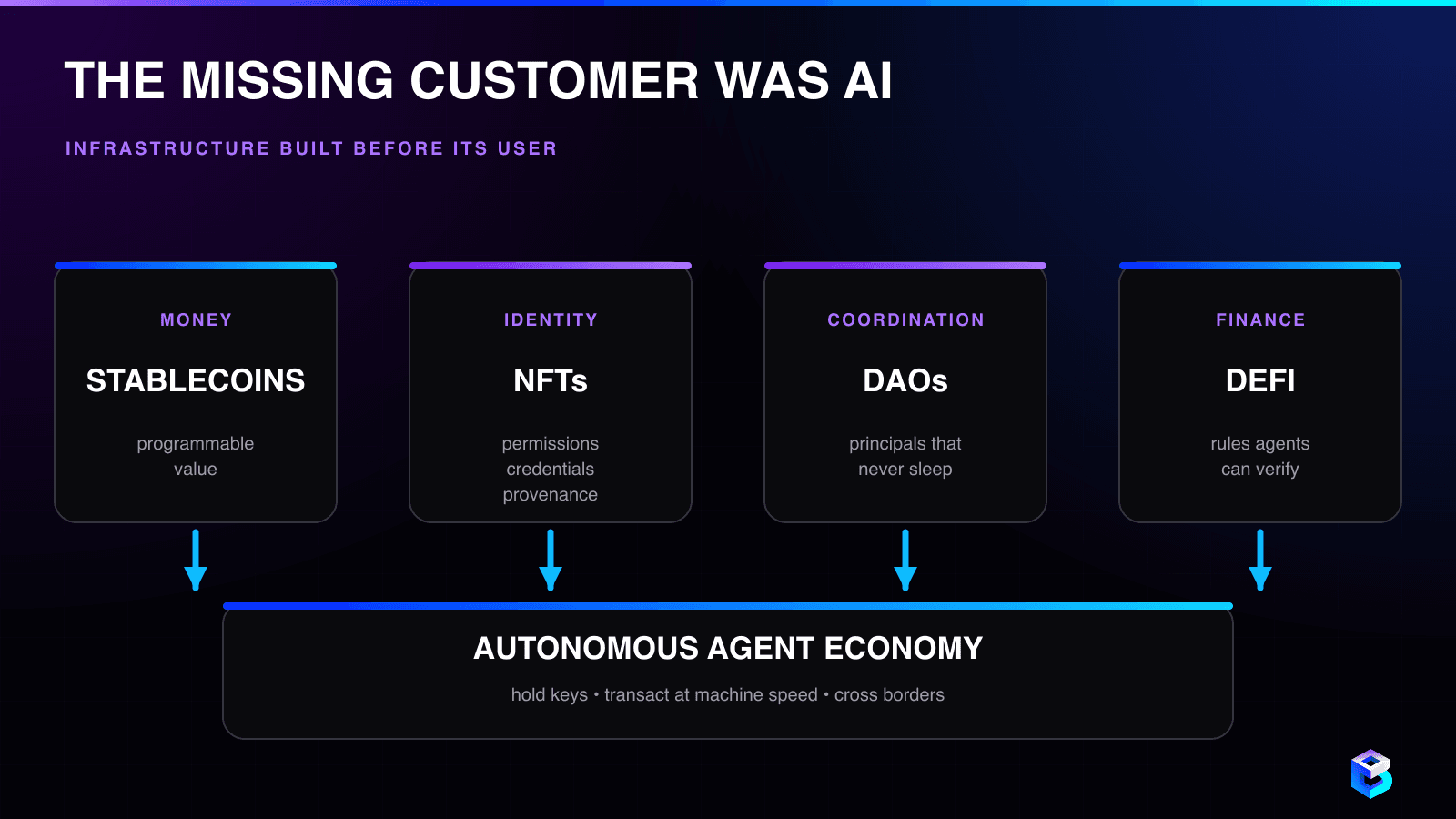
Every "failed" primitive of the last fifteen years starts to look like infrastructure built early, for a customer that didn't exist yet. Perez again: frenzies overbuild the canals. Deployment figures out what they were for.
The choice phase
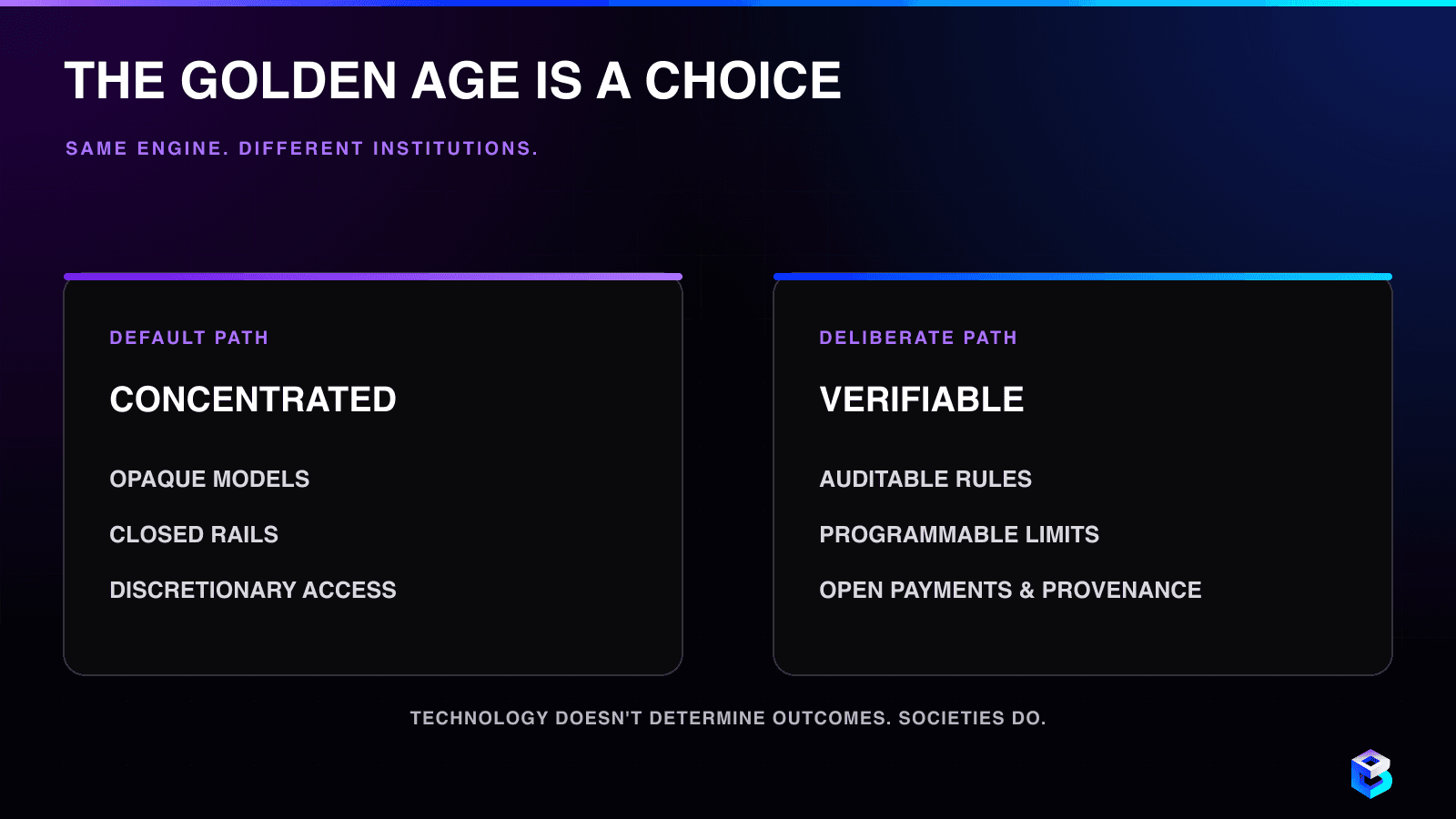
The part of Perez that crypto quotes least is the part that matters most right now. Her deepest claim was never about technology. Technology doesn't determine outcomes. Societies do. Every revolution reaches a fork after its turning point, and the shape of the golden age is chosen through institutions, policy, and social pressure. Mass production could have delivered only tanks and monopolies. The postwar settlement, the welfare state and suburbanization and cheap credit for ordinary families, chose to deliver a middle class instead. She has spent the years since arguing that the information age's golden age must be chosen just as deliberately, or the default will be more concentration and more surveillance.
Apply that to AI and the stakes stop being academic. The default path is concentration: a handful of labs, platforms, and states controlling the most powerful capability humans have ever built, with opaque models, closed rails, and accountability by pinky promise. Powerful entities bending a transformative technology toward their own ends isn't a hypothetical. It's the historical default Perez documented five times over.
This is the positioning our industry has to earn, then insist on. Blockchains are the tool a free society uses to harness and contain artificial intelligence without trusting any single party to do it. Verifiable rules instead of promised ones. Agent permissions and spending limits enforced in code anyone can audit. Provenance for money, content, and identity in a world of infinite convincing fakes. Payment and coordination rails that no platform, lab, or state can quietly deny. If AI is the engine of the next fifty years, blockchains are the brakes, the title registry, and the courts, decentralized so that no one sits above them.
That's a civilizational pitch, not a price pitch. It's also, per Perez, exactly the kind of societal choice that gets made or missed in the decade after a frenzy.
Stay early, stay sober
The next bull run will hallucinate the intersection of AI and crypto, and most of the specific hallucinations will be wrong. Agent-coin casinos will make the ICO era look dignified. Play with the earliest iterations anyway, because that's where you gain the advantage of being a native, and nativeness is the one edge that compounded through every prior cycle. The people who held keys in 2011 and farmed in 2020 didn't predict the future. They were fluent when it arrived.
Then hold two ideas at once, the way Perez taught us to. Amara's Law, the futurist Roy Amara's observation, applies doubly here: we always overestimate what will change in the next two years and underestimate what will change in the next ten. Two years from now, agents paying each other in stablecoins will look smaller than the hype. Ten years from now, an economy of machines transacting on rails no single power controls may look inevitable, if we choose it.
Revolutions install themselves. Golden ages are chosen.