October 23, 2026 · BTCD Team
They Need Yield
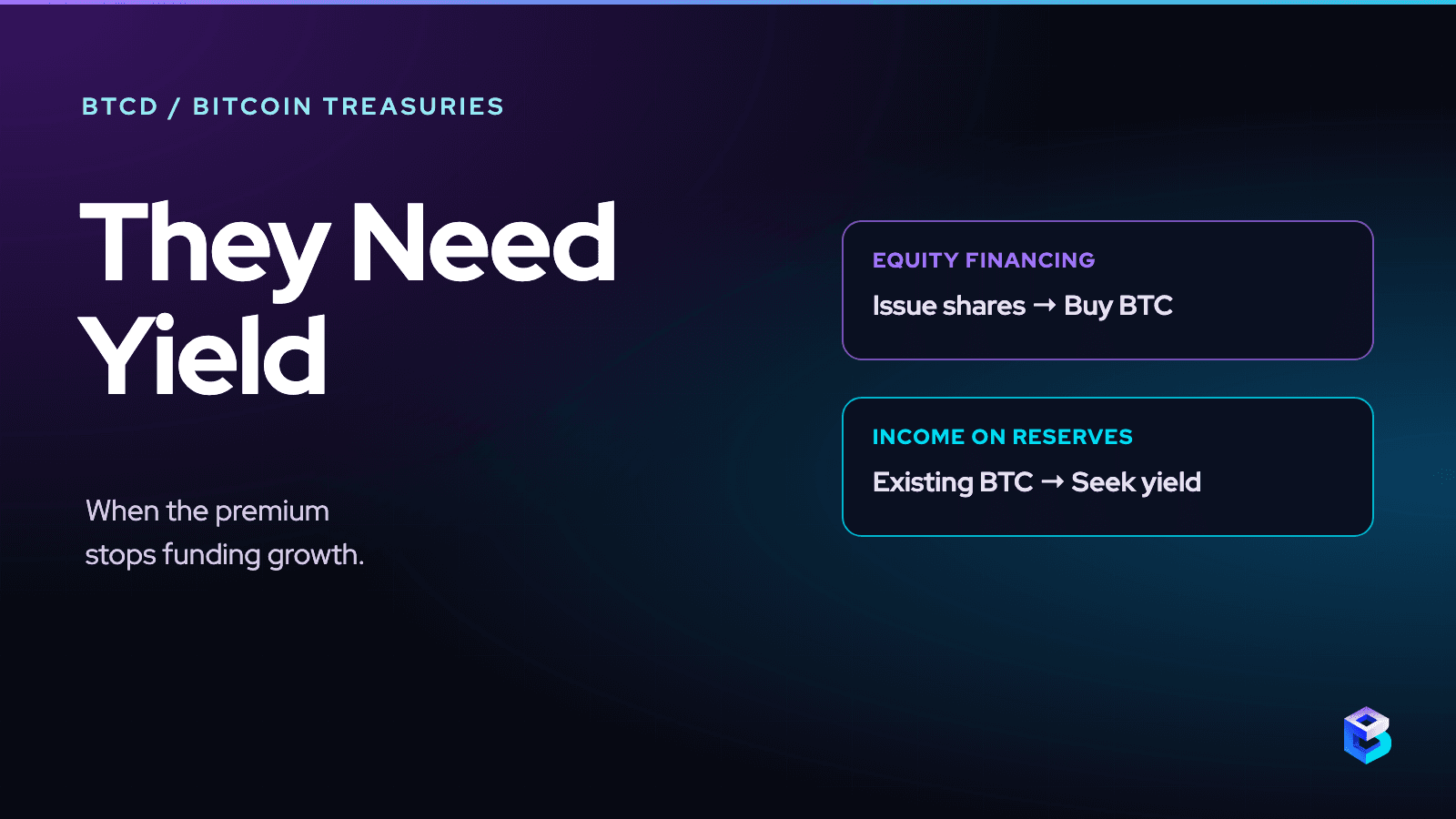
A BTC treasury company can own a valuable asset that earns nothing on its own: Bitcoin.
One route to growing a digital asset treasury, or DAT, is simple. Issue stock at a premium to the Bitcoin backing each share. Buy BTC. Repeat.
That engine runs on the premium.
When issuance stops helping
Take an illustrative company with 100 BTC and 100 shares. It starts with 1 BTC per share.
If investors pay the equivalent of 2 BTC per share, issuing 20 shares buys another 40 BTC. The company now holds 140 BTC across 120 shares: 1.167 BTC per share.
At 0.8 BTC per share, the same issuance buys only 16 BTC. The company now holds 116 BTC across 120 shares: 0.967 BTC per share.
This simplified example assumes all proceeds buy BTC at an unchanged price, with no fees, debt, other assets or other changes to the share count. Issuance above existing BTC backing per share adds to that measure. Issuance below it dilutes it. A smaller premium can still be accretive; the threshold matters.
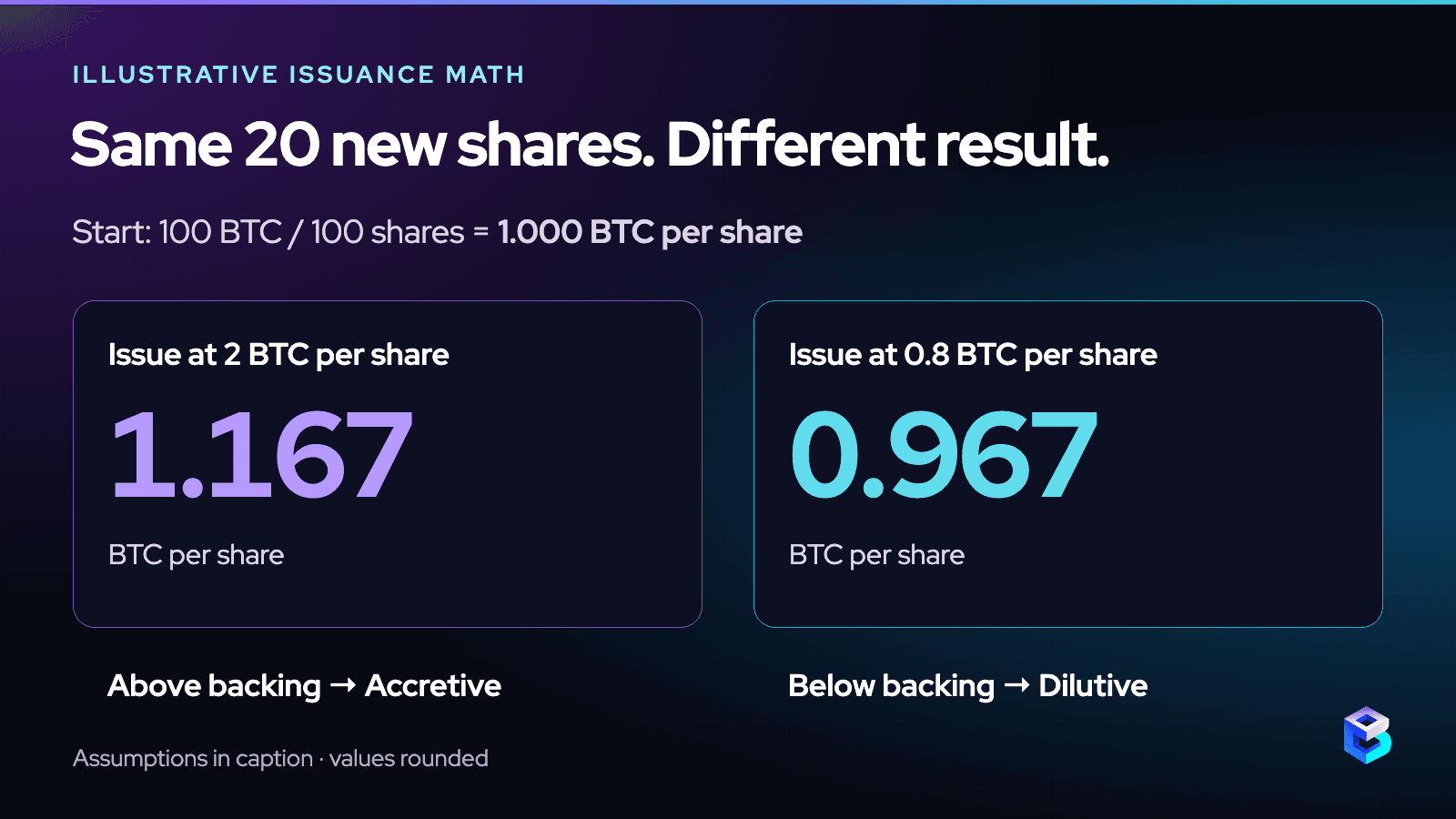
Starting with 100 BTC and 100 shares, issuing 20 shares above existing BTC backing is accretive; issuing below it is dilutive. Assumes an unchanged BTC price, all proceeds buy BTC, no fees, debt, other assets or other share-count changes. Values rounded to three decimals.
So the question broadens from “how much BTC do you own?” to “what does your BTC earn?”
When premium financing fades, management has a reason to look for a second source of value that does not depend on issuing new shares.
Positive net income on existing BTC, retained in BTC, can grow BTC per share without issuing equity. It also introduces risks beyond holding unencumbered Bitcoin. The source of that income matters.
How the carry works
The Bitcoin Dollar BTC Carry Vault is designed for this use case. Its published strategy describes a BTC position paired with a dollar carry:
- Deposit wBTC on Ethereum. wBTC represents Bitcoin through a custodial backing model.
- Use wBTC as collateral on Morpho to borrow USDC. The published strategy specifies a 65 percent loan-to-value target for the carry position. That is a strategy parameter, not a yield or a liquidation threshold.
- Deploy the borrowed USDC into bdUSD, Bitcoin Dollar’s yield-bearing dollar vault.
- Harvest positive net carry back into wBTC. The spread between bdUSD earnings and USDC borrowing costs funds this process, after applicable fees and execution costs.
This describes the carry leg. The vault also uses a wBTC lending buffer, explained in our Carry Vault overview.
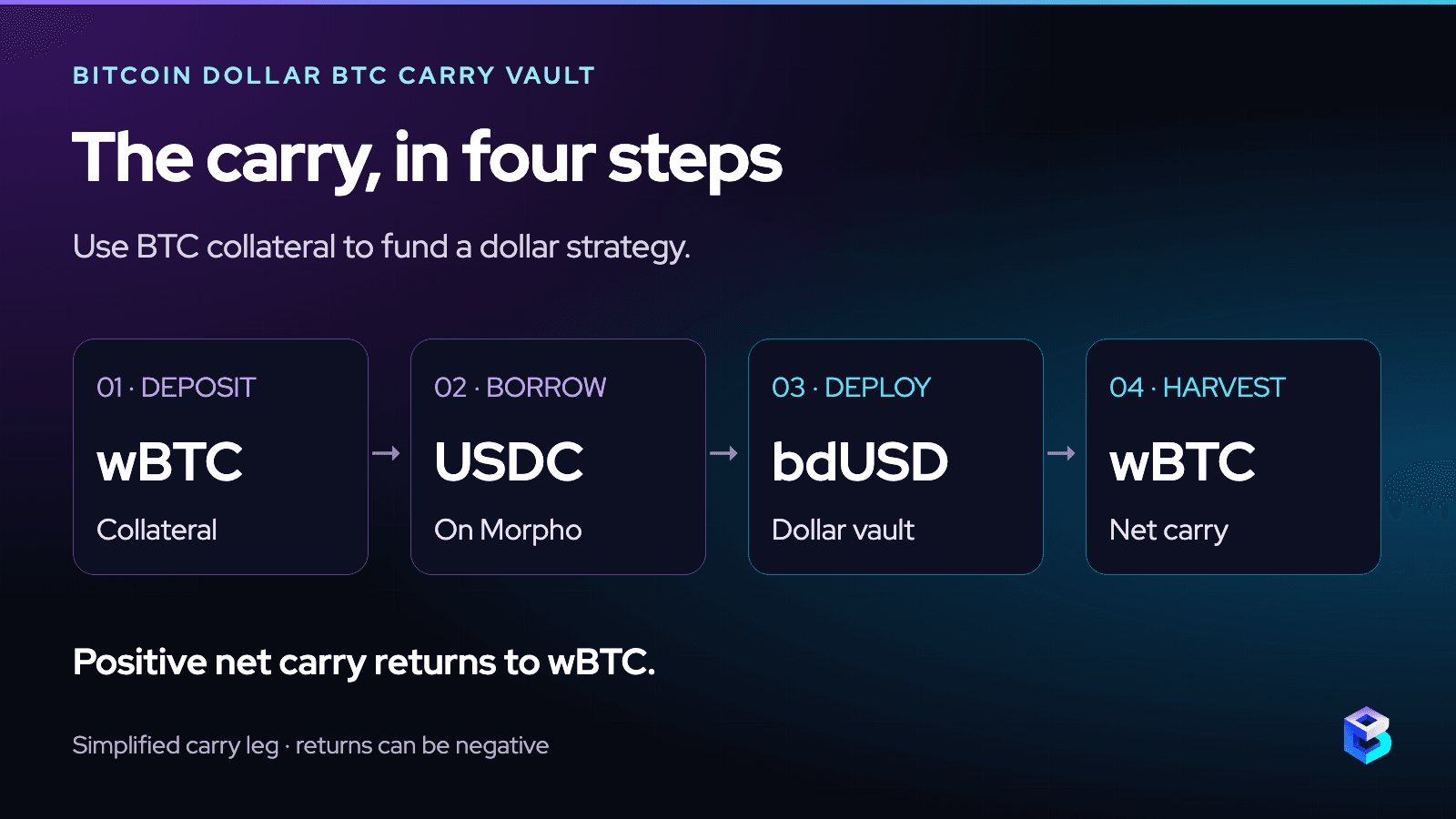
The carry leg uses wBTC collateral to borrow USDC into bdUSD, harvesting positive net carry back into wBTC after costs. Returns can be negative, and liquidation can reduce collateral. The article explains the 65 percent target and separate lending buffer.
The strategy uses wBTC as collateral rather than selling it to fund the dollar position. It is designed to retain BTC price exposure while accumulating returns in BTC terms. That does not guarantee preservation of the deposited BTC: losses or liquidation can reduce it.
For a DAT, successful execution can grow BTC per share even when the equity market will not fund accretive growth.
What to know
The carry can compress or turn negative if USDC borrowing costs rise or bdUSD earnings fall. A sharp BTC drawdown raises loan-to-value when the debt is unchanged, increasing the need to reduce debt and the risk of liquidation. On Morpho, an unhealthy position can lose collateral through liquidation.
wBTC adds custody risk. The strategy also depends on smart contracts, oracles, stablecoins and available liquidity. Read the protocol’s risk factors alongside the strategy. Returns are variable, and losses are possible.
The first generation of DATs competed on how much BTC they could buy. The next may compete on what that BTC earns—and the risks taken to earn it.
Running a BTC treasury? Let’s talk.